Category Archives: AOL

Going back to AOL 4.0…

I recently came across a project called NINA which has setup servers that the original AOL 4.0 software can talk to. After setting up a Windows 98 VM, installing AOL 4.0, and then configuring it to talk to NINA’s servers, I was able to log into AOL 4.0 for the first time in a very long time. It was pretty wild to hear the iconic “Welcome… You’ve Got Mail!” intro that I so often used to be greeted with. 

Since I was back in AOL, I was able to try out Mark Zuckerberg’s old fader apps, which I’d written about a few times previously. It was also cool to play around with some of the progs from the past. It was like a weird time machine.

Anyway, if you enjoy the video please like/comment/share, it seems to really help it in giving it a boost.

What the Github Story on AOL Hacking Culture Left Out

The Github ReadME Project has released a really nice story on the AOL hacking community. I’d heard they were working on an article a few months ago when a fellow dev from back in those days emailed me to say he’d discussed the idea with one of the editors. After that I talked with the article’s author, Klint, but I wasn’t sure if the story was going to come out. The era is 2+ decades old at this point, and it wasn’t clear to me if outsiders would really get what it was all about or if Klint would be able to round up enough information to make a coherent piece. He did a great job investigating and understanding the topic though, and it was cool to see the that article came to fruition. There was even a neat discussion of it at Hacker News.

As an aside, one amusing bit that was left on the cutting room floor was an antidote regarding Mark Zuckerberg that Ben Stone (author of Jaguar32.bas) had recently relayed to me. Leaving this story out was definitely for the best, as it would have been off topic and probably a distraction, but I figured I’d share it here as it’s a fun little story.

Zuckerberg’s AOL Origins

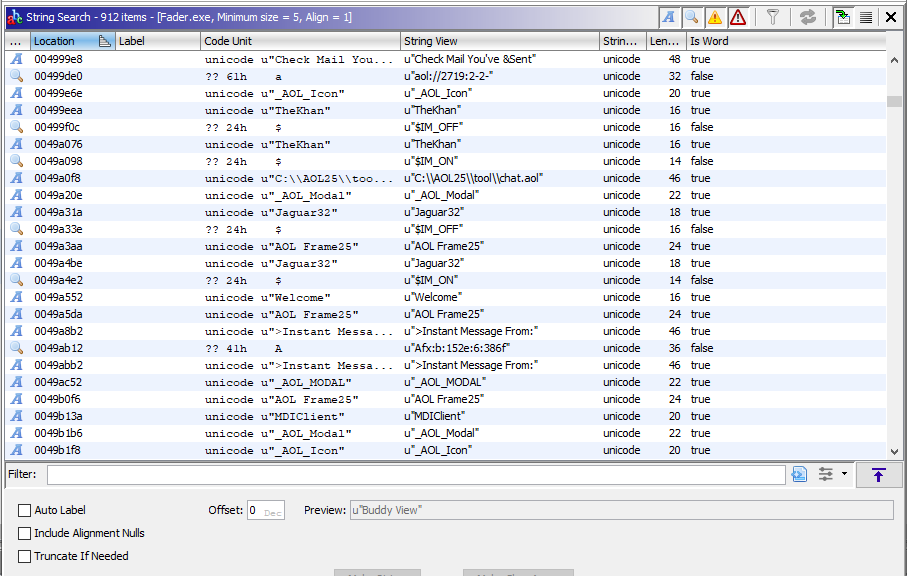
Before creating Facebook, Mark Zuckerberg cut his teeth in the AOL scene by creating the Vadar Fader. It’s a silly little app, though nothing to be ashamed of – I created one too (and it’s still actively used after all these years – a story for another time though). However, an interesting wrinkle was recently added to the story when Ben emailed me to tell me had been examining the Vadar Fader to see if it held any secrets. And well, he found something interesting. What did he find? After poking and prodding he decided to search for text strings inside of the exe file and discovered that Mark had used a well known bas file to create the Vadar Fader. Which bas file? Jaguar32.bas.

Discovering this apparently left Ben in shock, though I think in the back of his mind he knew it to be true. The reason he thought I might find this story interesting though was because he used my API Spy to help guide him through making Jaguar32.bas (along with help from Monk-e-god). It’s a bit amusing to think about, and there’s a joke about the butterfly effect in there somewhere, but I’m sure Mark would have created Facebook even if he’d taken a slightly different path.  

Would Mark Remember?

Even after 20 years I still remember bas files I used. They were my introduction to open source before I even knew what open source was. I even remember the very first one I used – genozide.bas. I sent so many emails to genozide for help with it that he got mad at me. And while I can laugh my part off as the butterfly effect in action, Ben’s work in the AOL hacking scene directly impacted one of the richest and most successful people on the planet, and that’s actually pretty cool.

What ever happened to the hacker known as Da Chronic?

A few nights ago a podcast featuring the infamous AOL-hacker Da Chronic showed up in my Twitter feed. The tweet and podcast didn’t garner a lot of attention, but Da Chronic and his 1995 app AOHell were legendary back in the day. With a set of features that allowed users to punt people offline, e-mail bomb, create fake accounts and more, AOHell caused untold amounts of chaos for AOL and its users. In the wake of its release it spawned a vibrant development community around creating “progs” – apps that augmented and added functionality to AOL (not all of these were for causing chaos, most were just for having fun). In fact, this site started as a Visual Basic help site for creating such apps. You can even still download the code generating API Spy I wrote back in the late 90’s, though unless you’re rocking Windows 98 it’s probably not going to be very useful.

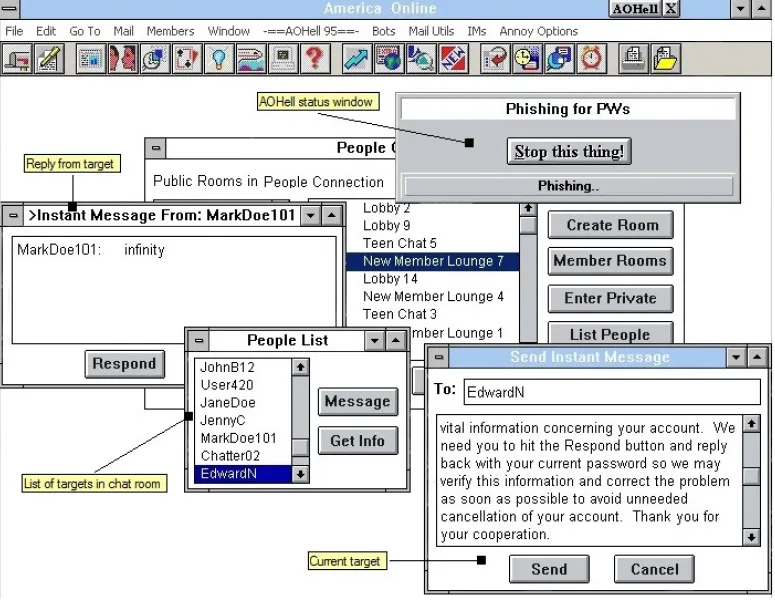
The podcast touched on a lot of things I hadn’t thought about in years. I remember AOHell being a little too malicious for my tastes, but I hadn’t realized that it had invented phishing. That may have been one of the reasons my friends and I quickly moved onto other progs, as I vaguely remember thinking I might get in trouble for using such an app. But then again, by the time I got AOL (summer of 97) the scene was flooded with progs, so maybe we just moved on because there were so many choices. One thing I do remember though was that Da Chronic was long gone by the summer of 97. It was like he dropped an atom bomb on AOL and then peaced out. At least that’s what it seemed like from the perspective of my 15 year old self.

AOHell’s Phishing Configuration – screen cap harvested from an archive.org version of justinakapaste.com

A decade ago I wrote about uncovering the identity of MaGuS, who’d written what most would say was the second most well known prog – Fate X. Fate X was like AOHell but without the quasi-illegal features (ie, the phisher and credit card faker). When I caught up with MaGuS he had become a successful developer at a large company. He seemed happy and it was apparent that being apart of the scene had been a positive experience for him. In contrast, Da Chronic’s experiences during this time period seemed to have left him paranoid and ultimately drove him away from a career in software. He also seemed somewhat guilt ridden over creating the first phishing app and coining the term for the attack. At one point he tried brushing this off by surmising that someone else would have invented the practice anyway if he hadn’t, but it still seemed to weigh on him as a blemish on his legacy.

Anyway, if you’re interested in computer security, were apart of the scene back in the day, or even if you’ve just made it this far into this blog post then I highly recommend the podcast below. It gives some great insight into one of the 90’s most infamous hackers. Even though I was more of a “white hat” progger I still owe a lot to this man. Before I stumbled into the AOL development scene I had been thinking of becoming a journalist. I can’t even imagine how different my life would be if I had taken that path.

Steve Case Confirms Zuckerberg as Former AOL Hacker

vader-fader

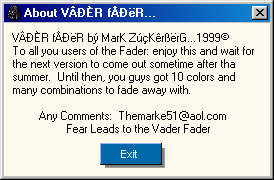
A year ago I wrote about Facebook founder Mark Zuckerberg’s possible AOL hacker roots. A 1999 angelfire website appearing to be his was uncovered, and it contained two AOL progs by “Mark Zuckerberg” – the Vader Fader and the Zuck Fader. The evidence that the Facebook founder had created progs in his youth was pretty compelling, and now AOL’s former CEO Steve Case has further verified this claim in his recent AMA (Ask Me Anything) by stating the following to someone who was apologying for their role in the AOL hacking scene:

Yikes! Well, I’m glad you got this off your chest! 🙂 The hacking of AOL was a real challenge for us. As AOL grew in prominence, it became a big target. Of course, some of the hackers have gone on to do more productive things. It sounds like that is the case with you, and it also was the case with Mark Zuckerberg! Went I first met him 6 or 7 years ago he said he learned how to program by hacking AIM! But, thankfully, rather than focusing on bring AOL down, he shifted to build Facebook up!

This probably means the Zuck had a collection of progs, knew about the various AOL *.bas files, and knew about AOL ASCII Art. That’s kind of cool when you think about it. I imagine he’s the most famous former AOL hacker.

Thanks to Kevin M. for alerting me to Steve Case’s post.

Was Mark Zuckerberg an AOL add-on developer?

mark_adjusted_350

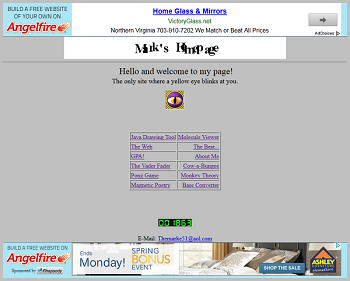
Facebook founder Mark Zuckerberg’s first website was recently found to still be online at Angelfire, an early free web hosting site. The Internet Archive confirms the site existed in its current form back in 1999, and the page’s source code is noted to be authored by “Mark Zuckerberg”. In addition, the author states they’re 15 (the age Mark was in 1999), and that they live outside of New York City (where Mark lived when he was 15). Motherboard provides further evidence, showing that the primary AOL account for the email listed on the site is a name commonly used by Mark Zuckerberg’s father.

The site screams 1999 web design, and is a very cool piece of internet archaeology. It should also be noted that it’s actually a pretty decent effort for the time for a 15 year old (you only have to see the About section of this blog to see my effort at 16). However, the most interesting aspect of the site is “The Vader Fader”, an AOL add-on application that Zuck was heavily promoting on the site. Did this mean he was apart of the AOL add-on community? Did he use AOL progs? Did he develop in Visual Basic?

vader

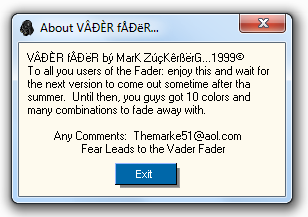
I downloaded The Vader Fader, and it is for AOL, and it was indeed written in Visual Basic. I tried firing it up, but got a message box saying I needed to be “online” and then the window on the left popped up. Ugh, I just want to see what this app looks like, I have to have AOL open? So I hunted down a version of AOL 4.0, installed it, and then tried running the app again. This time I got a runtime 6 error – this was most likely caused by Zuck using Integers to store window handles instead of Longs. After Windows 98, window handles started being Longs instead of Integers.

Being persistent, I decided to download Windows Virtual PC and load up Windows 98. After burning AOL 4.0, The Vader Fader, my API Spy, and a hand full of VB dependences to CDs and then loading them up on the OS, I fired up The Vader Fader. This time it didn’t crash, but it still told me I needed to be online. Crap… how was I supposed to do that? I tried signing on, to see if by some fluke AOL was still active and letting random people sign in, but it didn’t work. It then occurred to me – how did progs back in the day determine if someone was signed on? I couldn’t believe I remembered this, but the way it worked was the app would find the main AOL window, and then look for a child window that had a caption that started with “Welcome, “.

I used my API Spy to change the caption of the existing AOL sub-windows to “Welcome, PAT or JK”, and then tried launching The Vader Fader again. This time it worked! Well, sort of. Instead of a message popping up, the caption of the main AOL window changed to “The Vader Fader”, and then nothing happened. I poked around, and the app was running in the background, but there was no main window and it didn’t appear to have done anything else. My best guess is the app worked by augmenting AOL chat rooms and IMs with fading options (why else would it change the main AOL window’s caption?). If that’s the case, there really wouldn’t be much to see, or really any way to see it – given that AOL 4.0 chatrooms and IMs are long defunct.

I was a little sad, but glad I’d at least gotten the app up and running. I also ended up digging through the app’s machine code a little for any other clues on how it was created, but didn’t really find anything interesting (other than the 10 color choices). Since the app used the same online detection mechanism as most other apps at the time, I wonder if Zuck used a common bas file like dos32.bas or genocide.bas – that’d be pretty cool if he did. It’s also kind of neat that the main app he was pushing was a fader, since that was the first app I released on this site. Anyway, I’ve spent way too much time on this. The site is a cool piece of internet archaeology and definitely worth poking around a bit if you have a few extra moments.

Cracking MaGuS’s Fate Zero Encryption

I’m getting ready to upgrade my computer, and while going through some old files I stumbled across Fate Zero, the last version released of infamous Fate-X application. The tool was popular way back in the late 90’s since it added a lot extra functionality to AOL – some of which AOL was ok with, and some of which it wasn’t very fond of. It was created by two mysterious individuals known as MaGuS and FunGii. After Da Chronic (known for AOHell), MaGuS was probably the most widely known AOL hacker. Even though Fate-X 2.5 and 3.0 had a much bigger impact, Fate Zero was the most extensive in regards to features.

To maintain its status at the top of the heap, Fate Zero had to protect its external data, and this meant encrypting it so that other developers couldn’t snatch it up for their own progs. The prog scene of that time, however, is now long dead. Seeing these files today, I got curious. MaGuS was only 16 when he wrote Fate Zero. When I was 16, I knew almost nothing about encryption. It wasn’t until I was in college that I got a good exposure to the field of cryptography. Even though MaGuS seemed like a pretty smart guy, at that point in time he probably also didn’t know much about encryption. This made me think that the files might be easy to crack. It seemed like a fun way to spend a few hours, so I decided to see if I could decode them.

Interestingly (or not interestingly, depending on how you feel about it), the biggest source of external data for Fate Zero was AOL ASCII Art (ASCII Art done in 10pt Arial). This was typically used for scrolling into chat rooms. Fate Zero had over 500 files dedicated to this. You can see an example piece of art and its corresponding file encoding, below.

                         .--··´¯¯¯¨˜`·-.,
            .---··· ´¨¨¨                      `·.
       .·´                                        ',
    ,'                                               ',
   ¦             /|        |        /                  |
    ',     (     \\:\  |   /|      /''\     .|          |
      '·.  \|\ \.,'.|::\|\/ |¸,.-·´¨¨`·/.·´  |           |
         ` ·-\\|'/|¨`,     `|˜¨|¨˜`·„¸      |   |´¯`,    |
           ,'/||', \:'| ,     |_\::':/      |    |,  ,'     |
         ,'//|  ',¯¯·',                    |    | ¯        |
        ,'/  |  | ` ·.  --·´               |     |           |
        |´  |   |   _ ` ·.__ .·´        |      |/_        |
        |   |   |¨¯  ¯¯///,··\     ,.--·|      |  ',¯¨¨˜˜``'
        |.·´|   |--,··´¯//\ \ \    //   Aeka  _¸'·-By KioNe

File data for the above picture:

MDR恔…f”…f”…f”…f”…f”…f¡’ý)õý¦¡“rn~f”…f”…f”“sŽ¡ý”î
…f”…f”…f”…f”…f”…fÁ,“Sk…f”…f,f”…f”…f”…f”…f”…f”…f”…f”…f”…f”…mo恔…rˆ”…f”…f”…f”…f”…f”…f”…f”…f”…f”…f”…f”…fˆ rP”…쁔…f”…f”…f£áf”…f”…”…f”…f”…f”…f”…f”…f”…Ân~f”Œr”…fœ…f”…¢½®Áfð…f£áf”…f£Œm½”…f”“”…f”…f”áSk…f”…m¢…f½ðÁf½¢‘mðŸ€½ðÁuðr¡ú
Åý¢ú”áf”…f”…f”áSk…f”…f”Åf¡Á¢Ý›”Â
Ô‘f”…fÁðýîÝý¦øf”…fð…fðõÁ …f”áSk…f”…f”…f›”ÂÝ›‘f½®ŒÂ …f”…ÂÀП€ˆ®”f”…fð…f”ár”‘m”…fðrP”…f”…f Œuð…fˆ õ›‘f”…f”…f”…f”…f”…”…fÝ”f”…f”…Ân~f”…f”‘m”…”áfÁ”t”’s)…f”…f”…f”…fð…f”…”…f”…f”…Ân~f”…f”áú”áf”áf”ÄfÁ”tÀÓ…t)…f”…f”áf”…fð”¥”…f”…f݁o恔…f”…”…”…Â
$…f$”u ý½”…f”‘tŽ¡”…f”áf›‘õ
ýÞÁÔŒSk…f”…fð“ýð…fð’s,ú£”¢Ð…¢”…f£…fµÊ±Â”…¥›s£í…‘Ê㳫n~

So right away it’s clear he’s not using a simple substitution cipher, yet due to the repeated use of white space in the source data, a pattern does seem to emerge in the encoded data. I compared the file sizes and found MaGuS’ encoded *.mdr files to be 5 bytes larger than their decoded counter parts. I chalked this up to the “MDR” that prefixed all the files, and the ending carriage return and line feed that seemed to end all of the files.

That meant there was probably one-for-one character encoding going on. After trying a few things out, I realized every 4th character seemed to use the same encoding. My guess was that he was combining 4 simple substitution ciphers, and using a different cipher depending on the index of the character. I created a quick script that read in an input/output combination and then tried to use that information to decode an encrypted file. To my delight, the script (mostly) worked! This was great, however, without knowing the full map of each cipher, I would only be able to get partial results.

I looked further and found each cipher was simply doing a character offset, meaning each cipher was a Caesar Cipher. The offsets were 70, 97, 116 and 101, respectively. If you look up the corresponding ASCII code for those numbers, you get the word “Fate”. I tried out this new decoding strategy and was able to successfully decode a directory of MaGuS’ files. I had broken the code! MaGuS was using what is known as the Vigenere Cipher, and for that particular directory, “Fate” was the pass-phrase.

In another interesting twist, I noticed certain types of files used different Vigenere keywords. For his *.mdf data files, the keyword “12151981” was used. My guess was that this was his birthday, since this date would have made him 16 when the prog was released and he mentions that he was 16 in the app’s about section. In this same about section he also mentions that he’s Asian and what high school he went to. This narrows down who he is to almost a T.

This got me thinking: “I wonder if I can track down who MaGuS was?” With the aid of some crafty googling, email addresses taken from webpages mentioned inside of Fate (if you dig through the machine code, you’ll find a dozen or so URLs), Rapportive (which can be used to look up social profiles based on email addresses), the internet archive, and leads taken from Fate Zero itself, I was able to pin point an individual who fit all of the criteria and was friends with people who got shout outs in Fate. I plugged their name and the “12-15-1981” birthday into dobsearch.com, and only one result came back, and it was from the state and city MaGuS said he lived in. I was stunned, I had found MaGuS.

I feel like it’d be wrong to out him, but at the same time I know it’d be a cop-out to not say anything. So I’ll just say that according to his LinkedIn and Facebook, he works for a consulting firm in the Washington DC area and is specializing in web related work. The rumors of him working for a security firm or of being this guy are false. He also seems to be somewhat of world traveler, and has a side hobby of being a photographer.

Part of me wondered for a second if I should contact him. He was a big inspiration to me back in the day, and Fate-X and its ilk are what led me to learn how to program. However, after talking with my wife, we thought that’d be too creepy. He made some cool progs a long, long time ago, no need to freak him out with some elaborate story that involves breaking some encryption he wrote over a decade ago.

Anyway, after I’d finished my little side quest, and I realized I still had 500+ decrypted AOL ASCII Art files, many of which haven’t seen the light of day in over a decade. Since some of that stuff is kind of cool, I decided to create a gallery for it. If you have a few moments check it out. Also, feel feel to grab and host any art there that you like, just be sure to leave in any artist signatures. It’s kind of strange to think that era is so far away, but also kind of neat to find remnants of it every so often.

2013.04.28 Update: A bit more has happened since I made the original post. MaGuS actually emailed me to congratulate me on the finding and to confirm his identity (though I’ll continue to respect his anonymity). He also mentioned that at the time he wrote Fate he had no training or knowledge of programming, and that he came up with his own encryption method as he went along. I don’t fault him for this, as Fate is still really impressive and I think most of us were in the same boat back then. He seems like a pretty cool guy, and I was glad to hear he enjoyed the post.

2016.03.10 Update: To reconnect with fellow former AOL developers: